 89
89

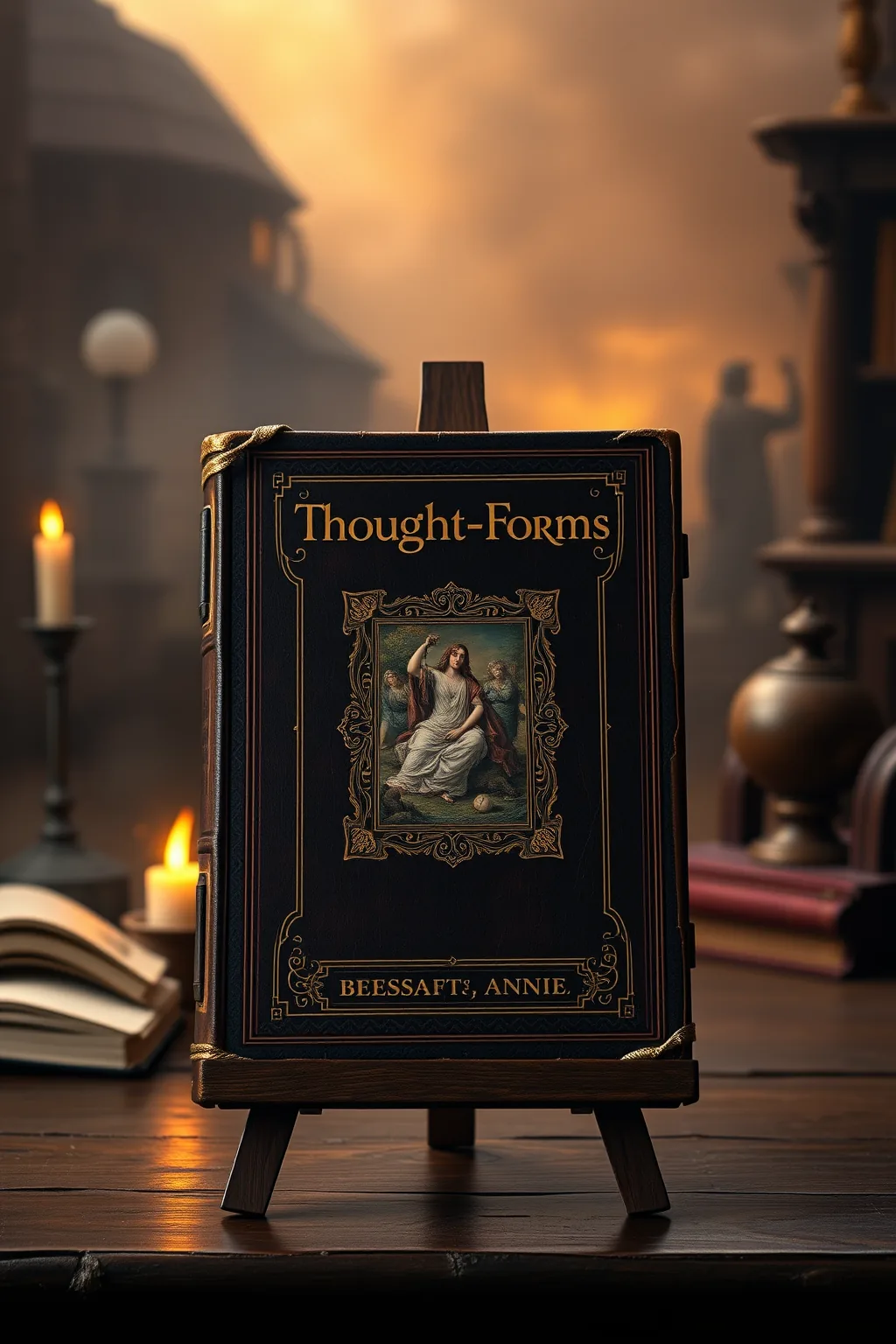
Thought-Forms
Annie Besant and C.W. Leadbeater published Thought-Forms in 1901.
This book examines the nature of thought as a force capable of creating tangible forms. Besant and Leadbeater detail how thoughts, particularly those with strong emotional content, can manifest as distinct shapes and colors in the invisible world. They describe these "thought-forms" as having a life of their own, influencing both the thinker and their surroundings. The authors illustrate this concept with numerous diagrams and descriptions of specific thought-forms, correlating colors, shapes, and intentions to particular mental states or emotions. The work aims to show that the power of thought is not merely abstract but has concrete, observable effects within the esoteric framework. The text explains how these manifestations can interact with other thought-forms and even affect individuals who encounter them. It suggests that understanding this process allows for greater control over one's mental environment and its external consequences. The authors draw upon Theosophical concepts to explain the mechanics behind these formations and their place within a larger spiritual understanding of reality. The book is intended for those interested in the practical application of mental discipline and the unseen influences that shape human experience.
📝 About the book: Thought-Forms
Look at the enigmatic world of Thought-Forms, a key work by Annie Besant, co-founder of the Theosophical Society. This esoteric treatise illuminates the mystical dimensions of thought and its tangible manifestations, inviting readers into a realm where ideas become tangible entities. Besant and Leadbeater's collaboration offers a wide range of symbolism and hidden knowledge, revealing the wide impact of our mental creations on the spiritual landscape. The book is a beacon for those seeking to understand the philosophical significance of thought in theosophical doctrine. It is designed for seekers of hidden wisdom, scholars of the occult, and practitioners of spiritual disciplines. The atmosphere is one of profound introspection and mystical revelation, where the boundaries between mind and matter dissolve into a unified field of consciousness.
💎 Expert review
📖 Why choose
Why this book is worth reading
Thought-Forms is essential reading for anyone interested in the mystical dimensions of thought and its impact on the spiritual world. This book is ideal for seekers of hidden wisdom, scholars of theosophy, and practitioners of spiritual disciplines. It offers a unique perspective on the power of thought, making it a must-read for those exploring the deeper layers of consciousness and the esoteric traditions.
⭐ Customer reviews
Customer rating
Thought-Forms by Annie Besant is a detailed look in esoteric insight, offering readers a profound exploration of the theosophical doctrine of thought as a tangible force. Besant's work, co-authored with Charles Webster Leadbeater, is a rich source of mystical symbolism and hidden knowledge. It stands as a evidence of the authors' deep understanding of the spiritual realm and their ability to convey complex ideas with clarity and depth. The book is particularly valuable for those interested in the intersection of thought and spirituality, providing a rich philosophical framework that is both intellectually stimulating and spiritually enlightening.
Arrived faster than expected and well packaged. Some chapters demand a slow, careful read, and that's exactly the point. It's become a regular reference in my practice. Happy enough with the purchase.
Been hunting for a decent copy of this text for ages. A text you study rather than simply read. Well worth it.
Needed this for my research. I appreciated how the argument builds steadily from first principles. One of my better finds this year.
As someone who reads a lot in this field, I can be picky. Not a light read, but far more accessible than I feared. It assumes more background than a beginner might have. Good, with the caveats above.
Ordered this after seeing it referenced in another book I was studying. It pairs well with more modern commentaries on the same tradition. Plenty of passages worth underlining; my copy is already full of margin notes. Some archaic spellings slow things down. Good, with the caveats above.